
Resilience in Washington’s wine industry
Although production in the US is largely dominated by California, Washington has become an increasingly well-known player in the wine scene over the last few decades. Today, it’s home to just under 1,000 wineries that produce around 122.5 million litres annually, and it is the second largest wine-producing state in the country. It’s best known for its premium Bordeaux-style red blends and Rieslings, but you’ll find a wide variety of styles on offer thanks to the region’s various microclimates and multiple American Viticultural Areas (AVAs).
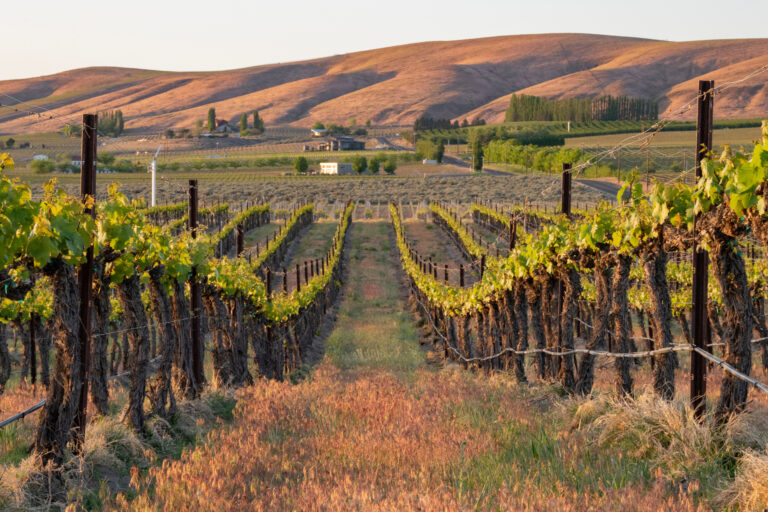
The Washington wine industry is a close-knit community made up of predominantly small, family-owned businesses across less than 50,000 acres of wine grapes. Most of the vineyards are located in Eastern Washington, where the vines benefit from a continental climate and rain shelter provided by two mountain ranges, the Olympics and the Cascades. The warm, dry summer days combined with large diurnal shifts and cooler harvest temperatures result in a mixture of Old World and New styles. But like the rest of the wine world, the region has not been immune to mounting climate pressures. Growers must grapple with increasing temperatures, wildfire risks, smoke exposure, extreme events, and water scarcity. And that’s not all. Add to that market volatility, trade pressures, oversupply and under demand, and it’s no wonder growers in Washington might be feeling challenged.
I recently spoke with Nathanial Helligso, operations manager and Sustainable WA Manager at the Washington Winegrowers Association, a non-profit trade association. It serves as the unifying voice for growers, vintners, partners and policymakers in the state, offering support through education, advocacy, and connection. In 2022, it launched the Sustainable WA certification, a science-based program that focuses on protecting the environment, supporting vineyard workers, and strengthening the long-term success of the wine industry. Tailored specifically for Washington’s vineyards, the rigorous Sustainable WA standard is updated each year based on a comprehensive feedback loop with growers.
Certified vineyards must follow strict standards to preserve soil, water, and resources, and are encouraged to adopt integrated pest management (IPM) practices. They must provide fair wages and safe working conditions for all workers. The standard also focuses on economic viability, requiring participating businesses to review their business practices, financial planning, and risk management. “Sustainability, when practiced right and taken to heart, forces you to have a holistic approach. Everything needs to be considered – the environment, the people, the economics,” notes Nathanial.
As of 2025, 124 vineyards totaling almost 15,000 acres were under Sustainable WA certification. Despite the challenging conditions, the industry has shown great resilience. “Watching farmers deal with challenges is so powerful,” says Nathanial. “How they continue to choose to do the right thing, even when it’s the hard thing. That needs to be recognized and celebrated.”
Read more about the Washington Winegrowers Association here.
Featured members