
Commercial common sense today, resilience for the future
(2 min read)
I’ve written a couple of times recently about the short-sightedness of anyone who sees ‘sustainability’ as a cuddly ‘nice to do’. I have argued that this is something which needs to be central to any strategy for a wine business to build resilience both now and in the future. It is not a fad, perhaps to appeal to apparent consumer preferences, but something that needs to be central to a rational commercial strategy.
Some might say ‘you would say that wouldn’t you, as you work in sustainability.’ However, it is not just me. The same argument is also being made by people running large wine companies, articulating how sustainability is central to how they run those businesses.
An example of this is a recent LinkedIn post from one of our most active members, Anne Bousquet. In this she said, “For years, the industry has posed the question, ‘Does sustainability sell wine?’ I believe this is the wrong focus.”
She argued instead that Domaine Bousquet had adopted sustainability practices not as a “trend decision”, but because “we believe it is the best way to care for our vineyards, enhance the quality of our wines, and create a business that will endure for generations.”
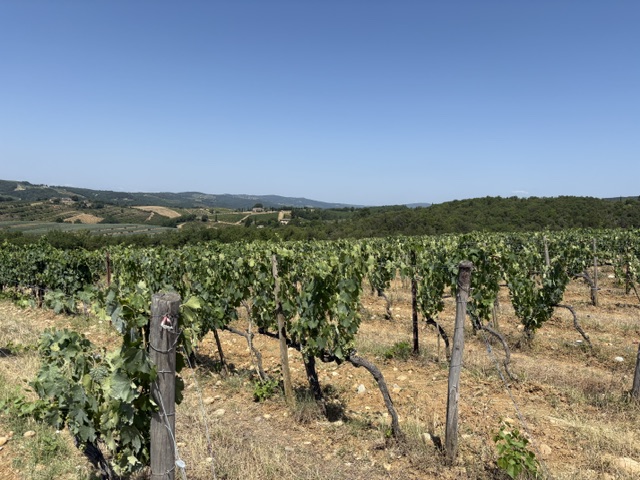
Last week, I had the great pleasure of visiting the Barone Ricasoli estate in Tuscany where I was hosted by Technical Director, Massimiliano Biagi. What I saw there echoed the same logic, that sustainable practices are central both to current profitability and to long-term resilience.
An example is the estate’s minimisation in use of chemical fertilisers. Yes, part of the rationale is that excessive chemical use damages soils over time. But there is also a much more pragmatic reason: cost savings. By using satellites and drones to map his vineyards, Massimiliano has a clear plan about which areas need fertilisation, and which do not.
The same logic was applied to pesticide use, which started with the understanding that pest risk differs across the estate, and therefore the response needs to be focused, not generalised. Ricasoli use sexual confusion techniques as the primary means of parasite control. Chemical interventions are used sparingly, and only when needed. Again, we see the use of precision viticulture as a means to not only enhance the long-term health of the vineyard, but also to manage costs and profitability.
However, it is also becoming clear that good sustainability practices will increasingly have a direct impact on a company’s core financial functions: insurance and financing.
It has not escaped the notice of insurance companies that climate change has a fundamental impact on the risk profile of companies in the agriculture sector. As a 2024 report by consultants PwC concluded, increasingly “agricultural insurance will be more responsive to impacts from extreme weather events and practices of sustainable agriculture to mitigate adverse impacts.”
Good sustainability practices look likely, over time, to also affect the interest rate and fees associated with bank funding. For example, it was announced in the UK that a number of financial institutions would offer benefits “including preferential lending terms, bespoke financial products, and transition support” to farms reaching certain sustainability criteria. A similar approach was announced also in New Zealand in 2023 by Westpac.
It is clear therefore that ‘doing sustainability’ is not a fluffy add on to be discarded if budgets get a bit tight. Increasingly it is something that saves money today and ensures the durability and resilience of a wine business in the future.
Featured members