
Sustainability at scale: How Vinmonopolet is transforming packaging in its supply chain
Alcohol monopolies are uniquely positioned to drive change at scale. They can transform production and supply chains through their purchasing power, and their role as exclusive alcohol retailers gives them a strong voice in the market. Vinmonopolet, Norway’s wine and spirits monopoly, has set an ambitious climate target to reduce supply chain emissions by 42% by 2030. I recently spoke with Rolf Erling Eriksen, environment leader at the organisation, to learn more about how they are working towards this goal.
Since January 2026, Vinmonopolet has had a lightweighting mandate in place. It requires all wines under NOK 250 (around £20) to be sold in bottles weighing maximum 420g. Although higher-priced wines are exempt to avoid these producers from exiting the Norwegian market, the rule has been designed for maximum impact, as 85% of Vinmonopolet’s sales fall within this lower price bracket.
Operating as a monopoly comes with its own complexities. Although lightweight bottles were already widely available, it took four years to implement the mandate. A range of legal constraints had to be navigated to ensure the policy did not create unfair burdens or violate any EU market principles. Supplier responses to the mandate have been overwhelmingly positive. “Suppliers have supported it. Cheaper bottles, equal treatment, lower emissions, it’s a thumbs up from almost everybody,” Rolf explains. Given that 420g is the maximum weight allowed, in practice this means suppliers have to go a bit below due to bottle weight variations. As a result, most bottles are between 380-390g, providing a buffer.
Vinmonopolet is also a signatory of SWR’s Bottle Weight Accord (BWA), committing to an average bottle weight below 420g by the end of 2026. For Rolf, one of the biggest benefits of the Accord is the opportunity for collaboration and knowledge sharing. Learning how other businesses are approaching lightweighting, particularly in the premium wine segment, has been especially valuable.
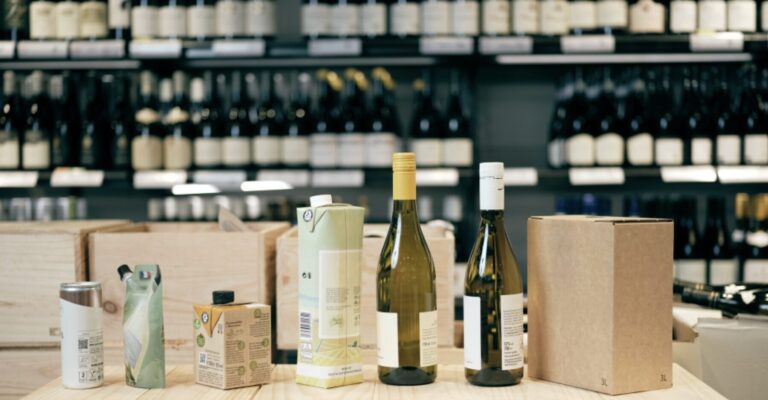
Beyond glass lightweighting, Vinmonopolet has also introduced stricter requirements for alternative packaging. All new tenders for PET wine bottles must contain at least 50% recycled content. Since the requirement was rolled out 18 months ago, around 20% of the PET bottles currently sold already meet the threshold. This puts Vinmonopolet ahead of the incoming Packaging and Packaging Waste Regulation (PPWR) baseline, which will require PET single-use beverage bottles sold in the EU to contain at least 30% recycled plastic by 2030. As a monopoly, however, Vinmonopolet cannot apply this requirement across its entire existing PET portfolio. It must first ensure sufficient market maturity and availability to avoid placing unfair burdens on suppliers.
Another popular format of alternative packaging in the Nordic markets is bag-in-box (BiB), accounting for 40% of Vinmonopolet’s sales. The monopoly has set certain requirements to improve the recyclability of the inner bags, as the commonly used black plastic in BiB packaging contains carbon, which acts as a contaminant and prevents automated sorting. To address this, Vinmonopolet has banned carbon black inner bags in its tender processes. Furthermore, aluminium foil cannot be used as an outer layer, as the aluminium coating prevents the bag from being recycled as plastic. While these change may seem minor, the impact has been significant. Millions of units have already transitioned to the new standard, improving recyclability.
Setting mandates and requirements can be challenging due to the legal complexities of operating as a monopoly. But when Vinmonopolet succeeds in implementing change, the impact is substantial. And it is not doing it alone. The monopoly collaborates closely with its Nordic and Canadian counterparts to align sustainability goals and drive progress on issues such as bottle weight reduction and spirits standardisation. Together, their collective market power helps accelerate systemic change, while also enabling the sharing of information, tools, and resources, much like through SWR. Read more about Vinmonopolet here.
Featured members