
A balanced approach to sustainability in Tipchenitsa, Bulgaria
Bulgaria’s long history of winemaking – with the earliest evidence dating back to 4000 B.C – was dramatically disrupted in the mid-1940s when the country came under Communist rule. The wine industry, just like all others, was nationalised and Bulgaria’s traditional, family-run vineyards were absorbed into state-run enterprises. These industrial production powerhouses focused on popular international grape varieties, prioritising quantity over quality. By the 1980s, Bulgaria had become the world’s fourth largest wine producer, exporting huge amounts of mass-produced Cabernet Sauvignon and Merlot to the USSR and the rest of the world, with a significant presence even in the UK.
Following the collapse of communism in 1989, a chaotic return to a market-based economy ensued. Since then, dedicated vintners have slowly rebuilt the sector, with a focus on small-scale, quality production, and the preservation of indigenous varieties such as Mavrud and Melnik. Today, Bulgaria ranks around 30th in terms of global wine production, with over 350 wineries spread across the country’s five distinct vine growing regions.
Tipchenitza Winery is one of them. Located in the Danubian Plain wine region in the northwest of the country, it sits around 600 metres above sea level. This elevation provides it with a unique terroir and the ability to produce higher-acidity wines than typical in warmer southern climates. Although a relatively new winery in terms of its current operations, the village has a long viticultural history. Records show evidence of viticulture in Tipchenitsa dating back to the early 20th century, shortly after Bulgaria was liberated from Ottoman rule. The village was especially well-known for producing vine planting material, a trade that developed into its main economic activity as early as 1907 and expanded further during communism. While some parts of Bulgaria saw a huge amount of viticultural knowledge and understanding lost during the communist period, local winemaking traditions and expertise survived in Tipchenitsa, passed down through generations.
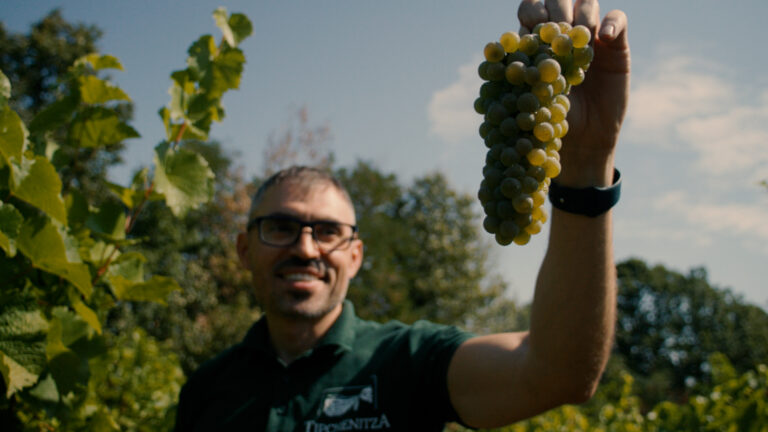
Last year, the 15-person team replanted a large portion of the winery’s 20 hectares of vines with more local varieties. These include Vrachanski Misket – a favourite among the old communist elite – and Rubin, a crossing between Nebbiolo and Syrah. Velin Djidjev, manager at Tipchenitza Winery, explains how they’re trying to showcase the different faces of the local varieties. “There’s growing interest in local varieties from both domestic and international markets, but people abroad are still not as familiar with them. That’s why we create blends of international and local grapes, such as Vrachanski Misket and Chardonnay, or Rubin and Cabernet Sauvignon.”
The vineyards used to be organically certified, but a changing climate has made this more challenging. The team now takes a more flexible, balanced approach to chemicals in the vineyard, using them only when necessary. Since its first vintage in 2018, wine has been sold in kegs, supplying wine-on-tap systems in local restaurants. To further reduce waste, the team plans to apply for EU funding to install a water waste recycling system.
Lightweighting is another key focus at Tipchenitza Winery, albeit a longer-term ambition that needs to be approached slowly. Bulgarian consumers are increasingly interested in sustainability, Velin notes, but misconceptions are rife, such as the belief that screwcaps or lightweight bottles indicate lower quality wine. Tipchenitza’s Tochka wine range uses 415g bottles, while their Oak Barrel range uses 460g bottles, with the exception of oaked red wines which remain in heavier glass. Trends develop more slowly in Bulgaria, Velin explains, so they can’t switch to lightweight bottles across all their ranges just yet, but the plan is to gradually phase out the heaviest bottles.
“Far too often we see a polarised view of sustainability – either you don’t care at all or you’re too fanatic. But that’s not how it works when you have a business.” As Velin aptly points out, sustainability requires work and balance. It’s not just environmental or social factors you need to account for, but economic sustainability too. Read more about Tipchenitza Winery here.
Featured members