
Long-term thinking at Château Larrivaux
Sustainability lacks a universal definition, but for many it conveys a responsibility to ensure longevity and protect resources for future generations. This philosophy has guided Château Larrivaux for over 400 years. Since 1580, the estate has been passed down from mother to daughter. Today, it is led by Bérangère Tesseron, who has managed the estate for the past 20 years. Her husband Basile joined her four years ago.
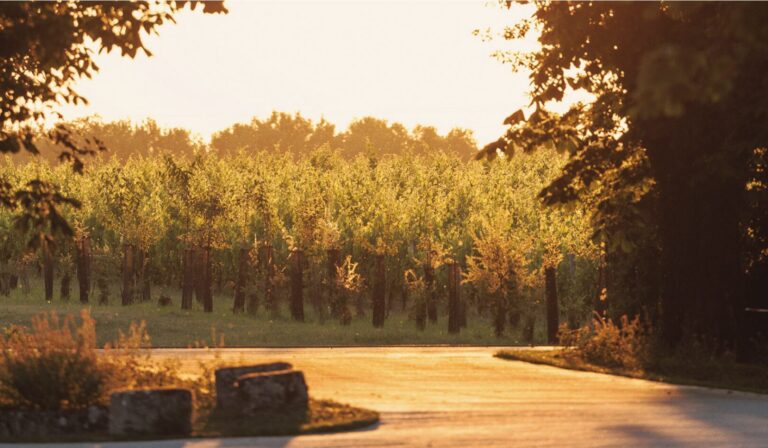
Located in Haut-Médoc, Bordeaux, between Saint-Estèphe and Pauillac, the female-led estate is unique in the region. Of its 100 hectares, only 20 are dedicated to vines. The vineyards, spread across four plots surrounding the estate, have been producing grapes since the 16th century. The rest of the land consists primarily of natural fields, forests, and old quarries, which provide the vineyards with their atypical sandy and limestone-clay soils.
Heritage and tradition are important to Château Larrivaux. The entire estate was recently refurbished, yet the original structure was preserved. You’ll still find the same stone walls and ceilings from over 200 years ago, made from the estate’s own quarries. However, preserving heritage for the future requires adapting to the demands of the present. As Basile tells me in a recent conversation, their primary focus is on making good wine – and ensuring they can continue doing so.
Heatwaves and drought already pose significant threats to the region. Basile shares how last year’s drought saw some plots produce nothing at all, as local deer, struggling to find food, began eating the vines. The winery is exploring ways to create more shade and to protect the vines from wind, which can dry out both clusters and soil. As in most of Bordeaux, irrigation isn’t permitted, but Basile notes they would avoid it even if it were allowed. Instead, the focus remains on soil protection and effective canopy management.
Generation after generation, nature has been protected at Château Larrivaux. The expansive, untouched forests and old quarries provide a protected habitat where wildlife can flourish. The estate is home to one of the largest bat populations in the region, with nine species recorded. This not only offers a fascinating site for scientists studying bats and their habitats, but it also directly benefits the vineyards. Bats have an appetite for certain pests such as the grapevine moth (Cochylis and Eudemis) and, with a single bat consuming between 1,500 and 1,900 insects per night, the estate has no need for insecticides.
Bérangère and Basile have continued the estate’s long history of agroforestry, having replanted 2 km of hedgerows and half a hectare of trees. In three to four years, they plan to plant vines at the base of these trees to study how the species interact with each other. Instead of using wooden posts or wires, the vines will be pruned to grow together with the trees. When asked about the expectations of this experiment, Basile says they have none: they are simply approaching the project with open curiosity.
Long-term thinking also needs to account for economic sustainability. As Basile stresses, winemakers must be able to make money so that they can keep on making wine for a living. The French wine industry has been under severe duress for the last few years due to structural and cyclical challenges such as oversupply, declining consumption trends, trade tensions, and climate change. Many winemakers are battling for survival, with some growers having had no choice but to uproot vines.
The ‘grubbing up’ scheme introduced by the French government last year saw around 12,000 hectares of vines destroyed in Bordeaux. Basile says he has seen a lot of uprooting take place amongst his friends and neighbours. It is “a nightmare that is far from over,” he laments. To support fellow growers, Château Larrivaux has invested in a négociant company in Bordeaux to help promote and distribute the community’s wine.
Despite the challenging circumstances, Basile remains positive. He strongly believes in the strength and resilience of the community. Amidst an uncertain landscape, Château Larrivaux offers a place of calm and harmony with a clear direction of travel. “We have four little boys. We want to be able to tell them in 25, 50 years that their parents did the right thing. They did it the right way,” Basile says. Find out more here.
Featured members