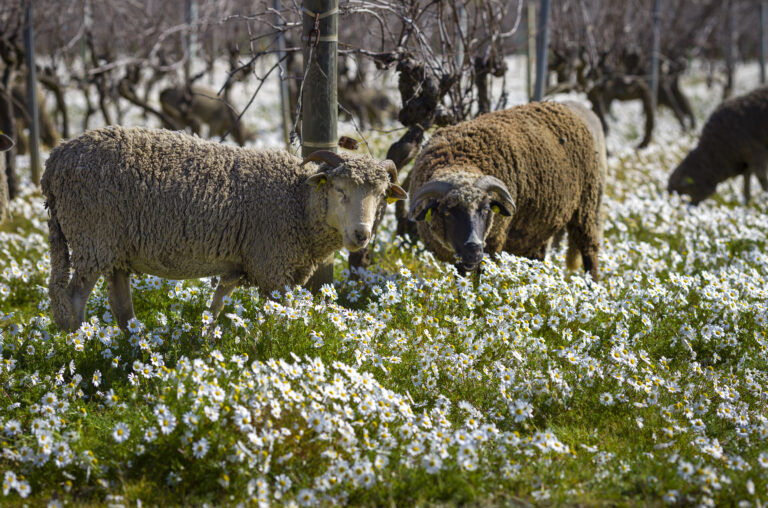

Grazing sheep and flowers in bloom: February at Château Léoube
Just as animals hibernate in the winter, grapevines enter a period of dormancy in the colder months. The vines drop their leaves, stop any active growth, and preserve their energy for the upcoming spring. The soil rests and recovers, preparing for the growing season ahead.
It’s easy to imagine a Northern Hemisphere vineyard as bare and brown at this time of the year. This is certainly not the case at Château Léoube, a 560-hectare organic estate by the coast in Provence, where life is thriving. Each February, local sheep arrive to graze freely among the vines and trees, as the bordering wild seed banks and chamomile flowers begin to bloom. The sheep provide natural weed management and soil fertilisation across the estate’s 70-hectare vineyard, 22-hectare olive grove, and market garden, whilst the growing vegetation feeds pollinators during these cooler months.
At Léoube, respecting and regenerating nature isn’t just part of a sustainability strategy. It’s the standard way of working. Since taking over the estate in the late ‘90s, the Bamford family has embedded three key principles, sustainable, seasonal, and local, across all of its operations. It was during a recent B Corp assessment process that the team realised just how much they were doing in terms of social and environmental sustainability – simply through what is very much a natural way of working for a French rural vineyard. They expect to be B Corp certified in the next few months.
Over half of the estate is left untouched, allowing wildlife to flourish in the surrounding coastal wetlands and forests. The biodiversity not only supports soil and vine health, but also provides ecosystem stability and resilience against extreme weather events. By protecting the surrounding nature, nature in turn protects the estate.

Everyone and everything is local at Léoube. They directly hire the same seasonal workers, sell orchard fruit to local artisans, and support small businesses through their supplier contracts. They host open workshops and vineyard tours for the community, run an apprenticeship scheme, and work with a number of local organisations such as Forestry Associations Suberaie Varoise and Foret Modèle de Provence.
Waste reduction and water conservation are also carefully considered. Packaging is minimal and recyclable. In the winery, leftover grape pulp is used to make distilled wine, while grape skins are turned into hand-stitched grape-leather wine lists for a sister brand. The estate’s restaurant, Café Léoube, has a seasonal menu which includes fresh ingredients from the market garden. The vineyard follows a zero-irrigation policy, but at times when irrigation is necessary, state of the art new sensors help determine exactly how much water is needed and where.
AgTech and innovation can sometimes feel at odds with the concepts of organic, traditional, and artisanal. But as Château Léoube eloquently demonstrates, they are by no means mutually exclusive. The estate takes pride in preserving Provençal winemaking methods and traditions. From planting and pruning to harvesting and sorting, all vines and grapes are strictly tended to by hand. While artisanal methods are prioritised wherever possible, the team doesn’t shy away from innovation.
As fourth-generation artisan Head Winemaker Romain Ott explains, “At Léoube the artisan knowledge handed down from generation to generation is vital for us to achieve consistently balanced wines that are true to their terroir. Alongside this we also make use of innovative new techniques and equipment in our cellar, especially when a modern approach offers greater precision or sustainability.”
Read more here.
Featured members